How Long Does SEO Take to Show Results?
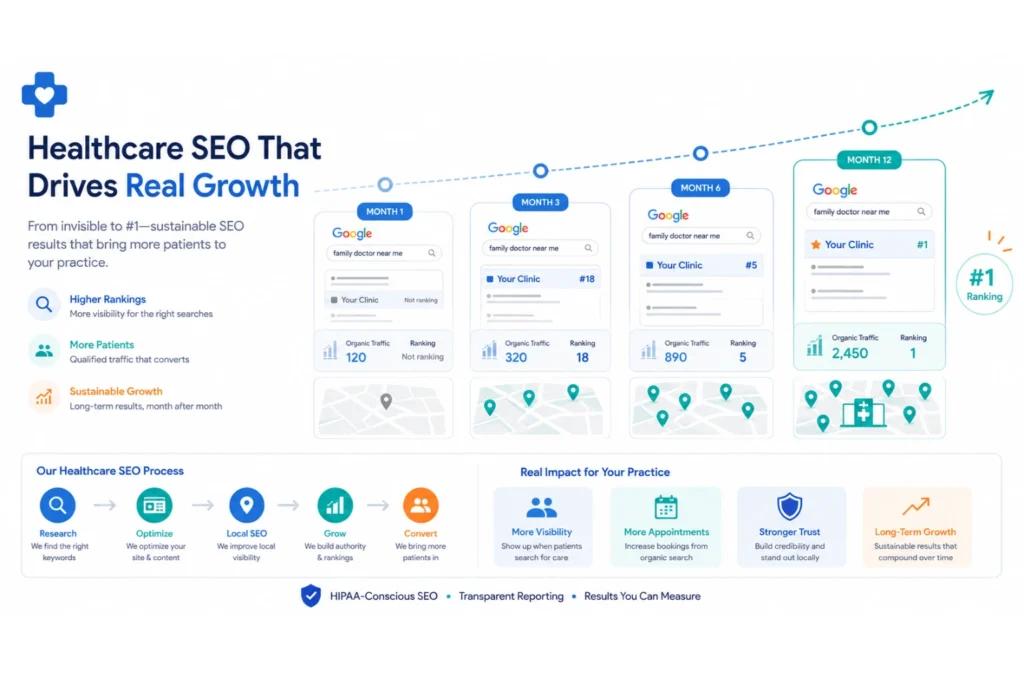
SEO is a long-term growth strategy. Most businesses begin noticing early movement in rankings and visibility within 3 to 4 months. Stronger traffic, leads, and consistent ranking improvements typically happen between 6 and 12 months depending on competition, website quality, local authority, content consistency, and technical SEO.
For local businesses like clinics, physiotherapists, eldercare providers, and healthcare services, local SEO improvements can sometimes appear faster if Google Business Profile optimisation and local intent targeting are implemented properly.
Why SEO Takes Time
SEO is not an instant advertising channel. Search engines evaluate hundreds of signals before deciding where a website should rank.
Google needs time to:
- Crawl your website
- Understand your content
- Evaluate topical relevance
- Compare your site with competitors
- Measure engagement signals
- Assess authority and trustworthiness
- Process technical improvements
This is why businesses searching for immediate traffic often misunderstand SEO timelines.
SEO is cumulative. Every optimisation builds on previous work.
What Is a Realistic SEO Results Timeline?
Month 1–2: Foundation and Technical Improvements
During the first phase, SEO work usually focuses on foundational improvements.
This includes:
- Technical SEO audits
- Fixing crawl issues
- Improving page speed
- Mobile optimisation
- Website structure improvements
- Keyword mapping
- Local SEO setup
- Google Business Profile optimisation
- Content planning
- Competitor analysis
Most businesses do not see major traffic growth during this stage.
However, search engines begin reassessing website quality after technical fixes and content optimisation.
Common Early Improvements
- Better indexing
- Improved crawlability
- Faster website performance
- Increased impressions in Google Search Console
- Better local map visibility
Month 3–4: Early Ranking Movement
This is usually when businesses begin noticing measurable SEO changes.
Search engines start testing pages for relevant search queries.
At this stage, businesses may see:
- Ranking movement for low-competition keywords
- Increased local visibility
- More keyword impressions
- Small traffic increases
- Higher Google Business Profile interactions
- Early lead generation from long-tail keywords
For healthcare providers and local service businesses, local SEO results can begin earlier if location-based competition is moderate.
Example Queries That May Begin Ranking Earlier
- physiotherapist near me
- eldercare services in [city]
- local clinic SEO services
- home healthcare provider near me
- healthcare SEO consultant
Month 5–6: Stronger SEO Momentum
By this stage, Google has more historical data about your website.
If SEO work has been consistent, businesses often notice:
- Higher rankings for target keywords
- Increased organic traffic
- More inquiries and leads
- Better engagement metrics
- Growth in branded searches
- Improved authority signals
- Better internal page indexing
This is also when topical authority starts influencing rankings.
Businesses publishing high-quality educational content consistently tend to accelerate growth during this phase.
Month 6–12: Compounding SEO Growth
SEO becomes more powerful over time.
As website authority grows, content rankings strengthen and search engines begin trusting the domain more consistently.
At this stage, businesses may experience:
- Significant traffic growth
- Higher local pack visibility
- Increased lead quality
- More branded search traffic
- Featured snippet opportunities
- AI Overview visibility
- Stronger keyword stability
- Improved conversion rates
This is where long-term SEO ROI becomes more visible.
What Factors Affect SEO Timelines?
Website Age and Authority
Older domains with existing authority often rank faster than completely new websites.
A new website has limited trust signals and requires more time to build credibility.
Competition Level
Highly competitive industries take longer.
For example:
- National healthcare SEO terms are more competitive
- Local physiotherapy SEO terms may rank faster
- City-based eldercare keywords may have lower competition
The more websites competing for the same keywords, the longer SEO typically takes.
Technical SEO Health
Technical issues slow down SEO performance.
Common issues include:
- Slow loading speed
- Broken links
- Poor mobile experience
- Crawl errors
- Duplicate content
- Weak site architecture
- Missing schema markup
Technical SEO creates the foundation for content visibility.
Content Quality and Depth
Thin content rarely ranks consistently.
Search engines prefer:
- Helpful content
- Expert-led information
- Clear structure
- Entity-rich language
- Question-based formatting
- Semantic relevance
- Accurate information
Healthcare-related content especially requires strong trust and clarity signals.
Local SEO Optimisation
Businesses targeting local searches can sometimes achieve faster visibility improvements.
This includes:
- Google Business Profile optimisation
- Local citations
- Local landing pages
- Location-specific keywords
- Review optimisation
- NAP consistency
For clinics and healthcare providers, local SEO is often one of the fastest ways to improve search visibility.
Backlink Quality
Authority backlinks help search engines trust a website faster.
However, low-quality backlinks can negatively affect SEO.
Businesses should focus on:
- Relevant backlinks
- Healthcare industry mentions
- Local authority citations
- Educational content links
- Brand mentions
How Long Does Local SEO Take?
Local SEO timelines are often shorter than national SEO campaigns.
Businesses may begin seeing local visibility improvements within 2–4 months if:
- Competition is moderate
- Google Business Profile is properly optimised
- Local pages are structured correctly
- Reviews are consistently managed
- Technical SEO is healthy
However, highly competitive cities may still require 6–12 months for strong local rankings.
Why SEO Feels Slow to Business Owners
Many business owners compare SEO to paid advertising.
Paid ads generate immediate visibility because businesses pay for placement.
SEO works differently.
SEO builds long-term authority and sustainable organic visibility.
Unlike ads:
- SEO traffic does not stop immediately when spending stops
- Organic trust is stronger
- Click-through rates are often higher
- Long-term ROI compounds over time
SEO is slower initially but often more sustainable.
What Results Should Businesses Expect in 3, 6, and 12 Months?
After 3 Months
Businesses may notice:
- Improved indexing
- More keyword impressions
- Initial ranking movement
- Better local visibility
- Small traffic growth
After 6 Months
Businesses often experience:
- Steady traffic growth
- Ranking improvements
- Increased lead generation
- Better keyword positioning
- Higher engagement
After 12 Months
Long-term SEO campaigns may produce:
- Strong organic lead flow
- Stable rankings
- Better brand authority
- Increased branded search volume
- Greater local trust
- Improved conversion quality
Is SEO Worth the Wait?
For most service-based businesses, SEO becomes one of the highest ROI digital marketing channels over time.
This is especially true for:
- Clinics
- Physiotherapy centres
- Eldercare providers
- Home healthcare services
- Local healthcare businesses
SEO helps businesses:
- Reduce dependency on paid ads
- Increase long-term visibility
- Build trust with patients and clients
- Generate inbound leads
- Improve online authority
The businesses that benefit most from SEO are usually the ones that remain consistent.
SEO Timeline for Healthcare And Eldercare Providers
Healthcare and Eldercare SEO often requires stronger trust signals because healthcare content falls under Google’s YMYL (Your Money or Your Life) standards.
Healthcare businesses should prioritise:
- Accurate content
- Author expertise
- Local authority
- Technical SEO
- Structured data
- Review management
- Educational content
Healthcare SEO may take longer in competitive markets, but it often delivers high-quality leads because users searching for healthcare services usually have strong intent.
How to Speed Up SEO Results
Focus on Technical SEO First
Technical problems delay indexing and rankings.
Prioritise:
- Page speed
- Mobile optimisation
- Schema markup
- Crawlability
- Core Web Vitals
Publish Helpful Content Consistently
Content consistency improves topical authority.
Focus on:
- Service pages
- FAQ content
- Location pages
- Educational blog posts
- Search-intent alignment
Improve Internal Linking
Internal links help search engines understand topical relationships.
Link:
- Blog posts to service pages
- Service pages to location pages
- FAQs to related content
- Related healthcare SEO topics together
Optimise Google Business Profile
For local businesses, Google Business Profile optimisation directly affects local visibility.
Maintain:
- Updated business information
- Relevant categories
- Service descriptions
- Reviews
- Photos
- Regular updates
Frequently Asked Questions
How long does SEO take to work?
Most businesses see measurable SEO progress within 3–6 months, while stronger traffic and lead growth often take 6–12 months.
Why is SEO slow?
SEO takes time because search engines evaluate trust, authority, content quality, competition, and technical performance before improving rankings.
Can local SEO work faster?
Yes. Local SEO may show earlier visibility improvements, especially for businesses with low-to-moderate local competition.
Does SEO work for healthcare and Eldercare providers?
Yes. Healthcare and eldercare businesses benefit from SEO because patients frequently search online for local healthcare services and providers.
What affects SEO ranking speed?
Competition, technical SEO, content quality, backlinks, domain authority, and consistency all influence SEO timelines.
Is SEO worth it for small businesses?
Yes. SEO can become a long-term lead generation channel that improves brand visibility and reduces dependency on paid advertising.
Why Long-Term SEO Investment Delivers Sustainable Business Growth
SEO is a long-term investment, not a quick fix.
Businesses expecting instant rankings often become frustrated because SEO requires trust-building, content consistency, technical optimisation, and authority development.
However, businesses that invest consistently in SEO often achieve stronger long-term visibility, sustainable traffic, and higher-quality leads.
For healthcare providers, clinics, physiotherapists, eldercare businesses, and local service providers, SEO can become a major growth channel when implemented strategically.
Key Takeways
- SEO usually takes 3–6 months to show measurable progress.
- Competitive industries may take 6–12 months or longer.
- Local SEO can show earlier visibility improvements.
- Technical SEO issues can delay rankings.
- Content quality and topical authority strongly influence SEO speed.
- Consistent SEO work compounds over time.
- SEO results depend on trust, authority, competition, and website health.
Want to understand what is slowing down your SEO growth?
Ranking Solutions helps healthcare providers, clinics, eldercare businesses, and local service companies improve:
- Local visibility
- Technical SEO
- Google Business Profile performance
- AI search optimisation
- Organic lead generation
Request an SEO audit to identify technical gaps, local SEO opportunities, and ranking barriers affecting your growth.